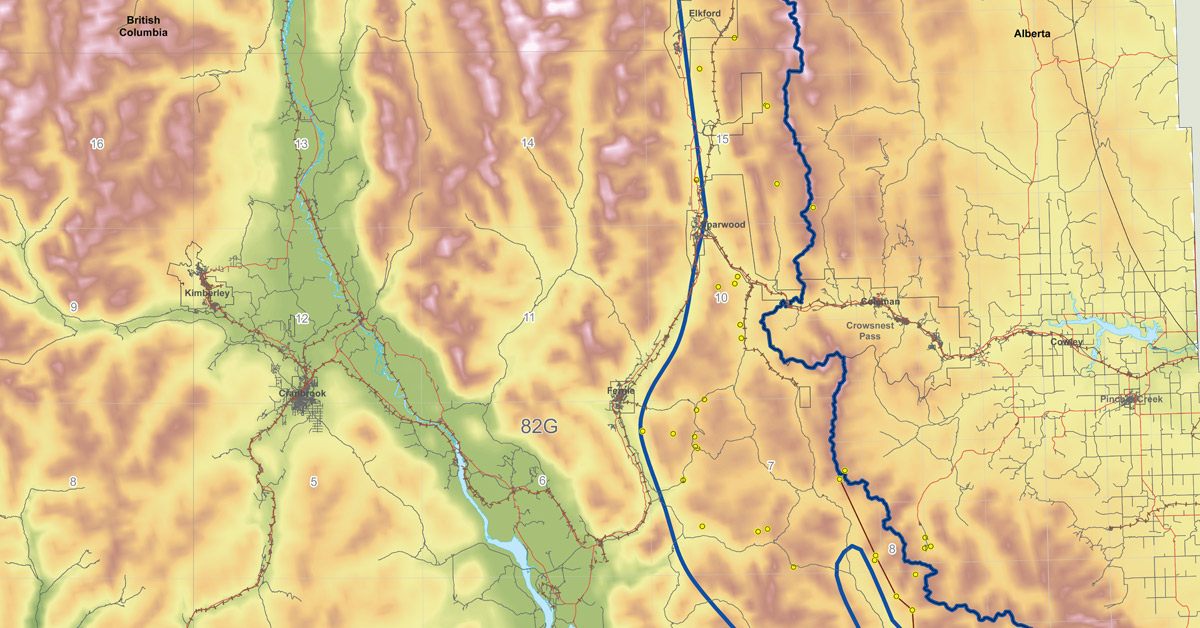
Carbon Storage Potential Assessment of Fernie Basin evaluates depleted hydrocarbon reservoirs and saline aquifers, integrating publicly available geological, well, hydrodynamic, pressure, temperature, and historical seismic data to assess reservoir quality, containment, structural closure, and storage resource. Because well and wireline-log coverage is sparse, the study uses ranges of reservoir parameters and storage-efficiency factors and applies Monte Carlo analysis to account for uncertainty.
Three large prospective storage areas, described as “mega-compartments,” are identified. The most promising reservoir intervals include porous dolomites and limestones within the Mississippian Mount Head and Livingstone formations and the Devonian Palliser, Nisku, and Peechee/Leduc formations. The study emphasizes that structural complexity, fault behaviour, reservoir continuity, and seal integrity remain important uncertainties requiring additional investigation.
Estimated effective CO₂ storage capacity at the P50 level is 55 Mt for Area 1, 114 Mt for Area 2, and 68 Mt for Area 3. At an injection rate of 2 Mt per year, these estimates correspond to approximately 27.5, 57, and 34 years of storage, respectively. The report concludes that all three areas contain sufficient indicative storage potential to justify further carbon capture and storage feasibility work.